The Children's Studies Bookshelf

The Children's Studies Bookshelf

About the Project

This project has been in the works for well over a year, and I am delighted to share our inaugural  Children’s Studies Bookshelf this month!  As the project continues, new Bookshelf collections will be available on this page, assembled by a series of guest curators whose areas of expertise reflect the interdisciplinary nature of the WashU Children’s Studies program. We will engage with the history of book production for children and teens, from its early days to the present, providing snapshots of different moments in that history across a variety of disciplines.

The concept of the “bookshelf” is an important one to Children’s Studies, reminding us of the powerful influence of ongoing reading experiences during the formative years.  While each book makes its contribution, no single book can do everything.  Children’s literature scholar Rudine Sims Bishop, in her landmark essay “Windows, Mirrors, and Sliding Glass Doors,” observes that “Books are sometimes windows, offering views of worlds that may be real or imagined, familiar or strange…. Literature transforms human experience and reflects it back to us, and in that reflection we can see our own lives and experiences as part of the larger human experience.” She concludes by stressing the need for a multiplicity of books, “ones that can act as both mirrors and windows for all our children.”  Author and illustrator Grace Lin, building on Bishop’s metaphor, agrees, asking parents and educators: “What is on your child’s bookshelf?”  The best bookshelves are diverse in all respects, offering different readers what they need at different times – affirmation or discovery, comfort or challenge - while broadening their worlds. Our Bookshelves, in turn, will showcase a range of scholarly views and perspectives, drawing from various fields and including both fiction and nonfiction.

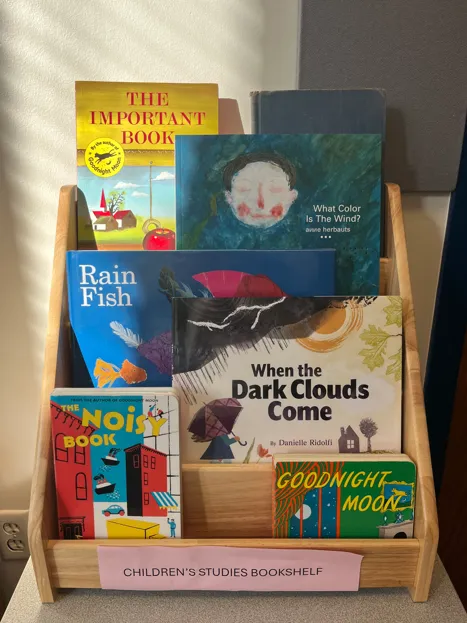
Inherent in the idea of the bookshelf is the promise of possibility: there is always another volume to reach for.  In our case, there is a literal bookshelf, housed in the English Department office; here, visitors are encouraged to reach for these texts and examine them, discovering the stories told by their physical presence as well as by their contents.  Is the text a gilded hardcover or a tattered paperback?  Are the pages the color of weak tea or are they a glossy white? What do the inscriptions on the inside cover tell us about the book’s genealogy of readers?  Has a child colored on its pages, pasted in a picture, or scrawled a response to a favorite passage or character? Pick one up - and find out!

                                                                                                                      Amy Pawl

                                                                                                                      Director, Children’s Studies

                                                                                                                      September, 2025

I would like to thank Abram Van Engen, chair of the English Department, and Hannah Ryan, the Children’s Studies Academic and Administrative coordinator, for making this project possible.
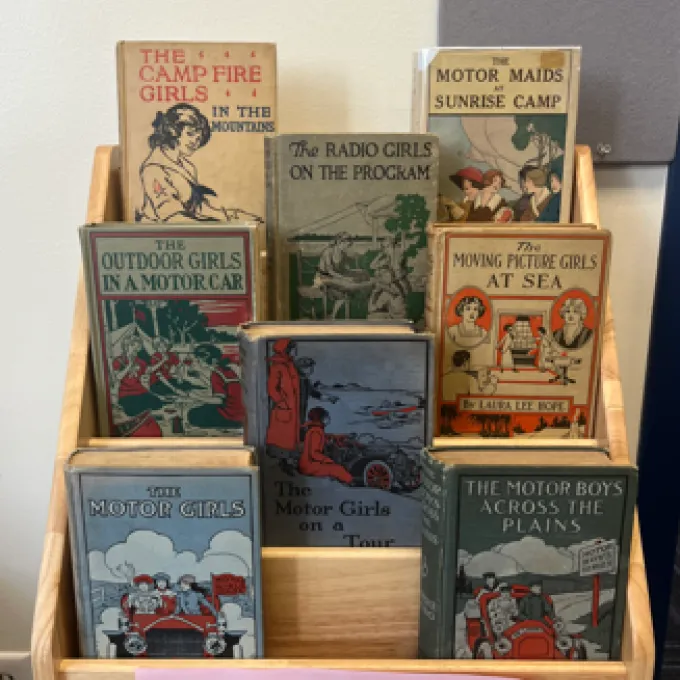
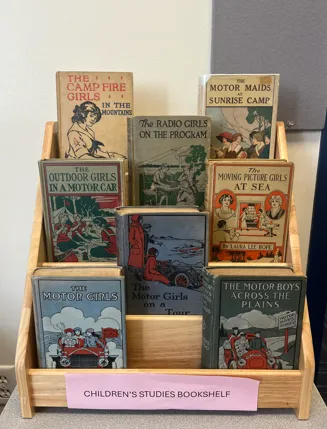
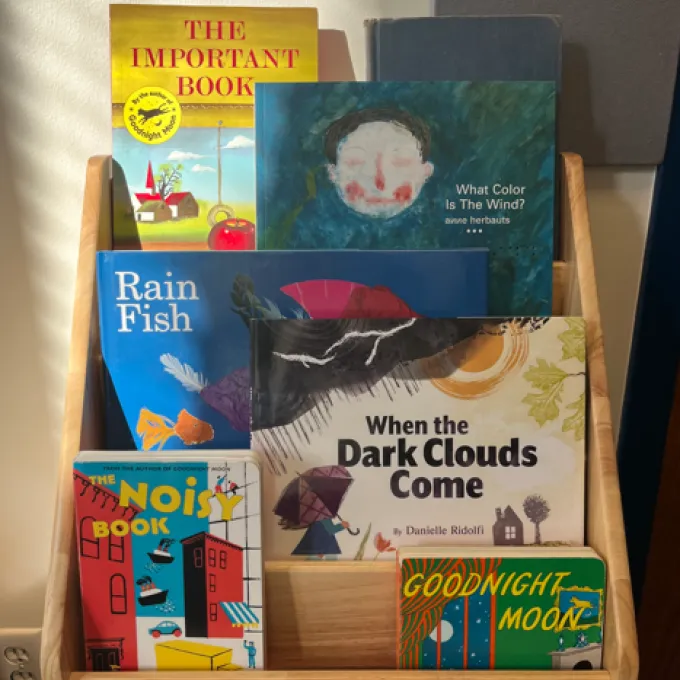
 

Bookshelf Available in English Office!

While this website serves as an online presence for the Children's Studies Bookshelf, all of the books you see here are available to browse and read in the English Office in Duncker Hall. Stop by and check it out!

Jan/Feb Children's Studies Bookshelf

Esperanza Rising

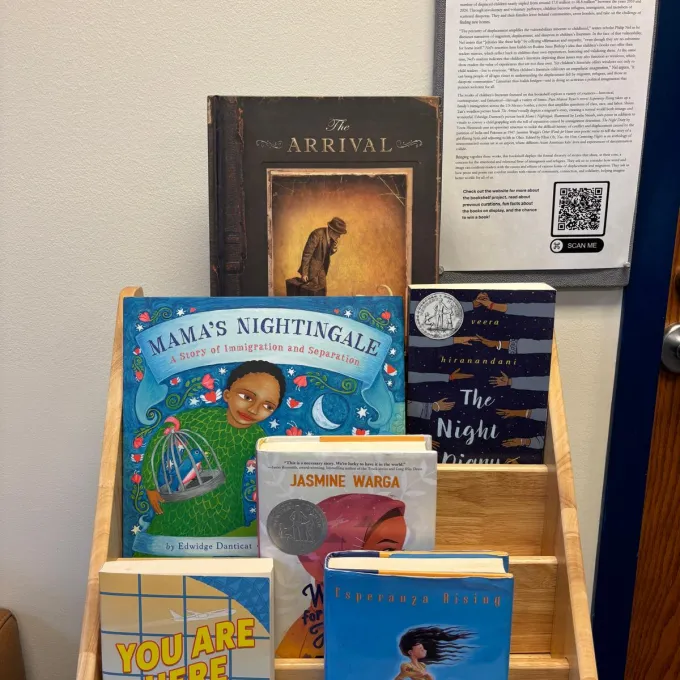
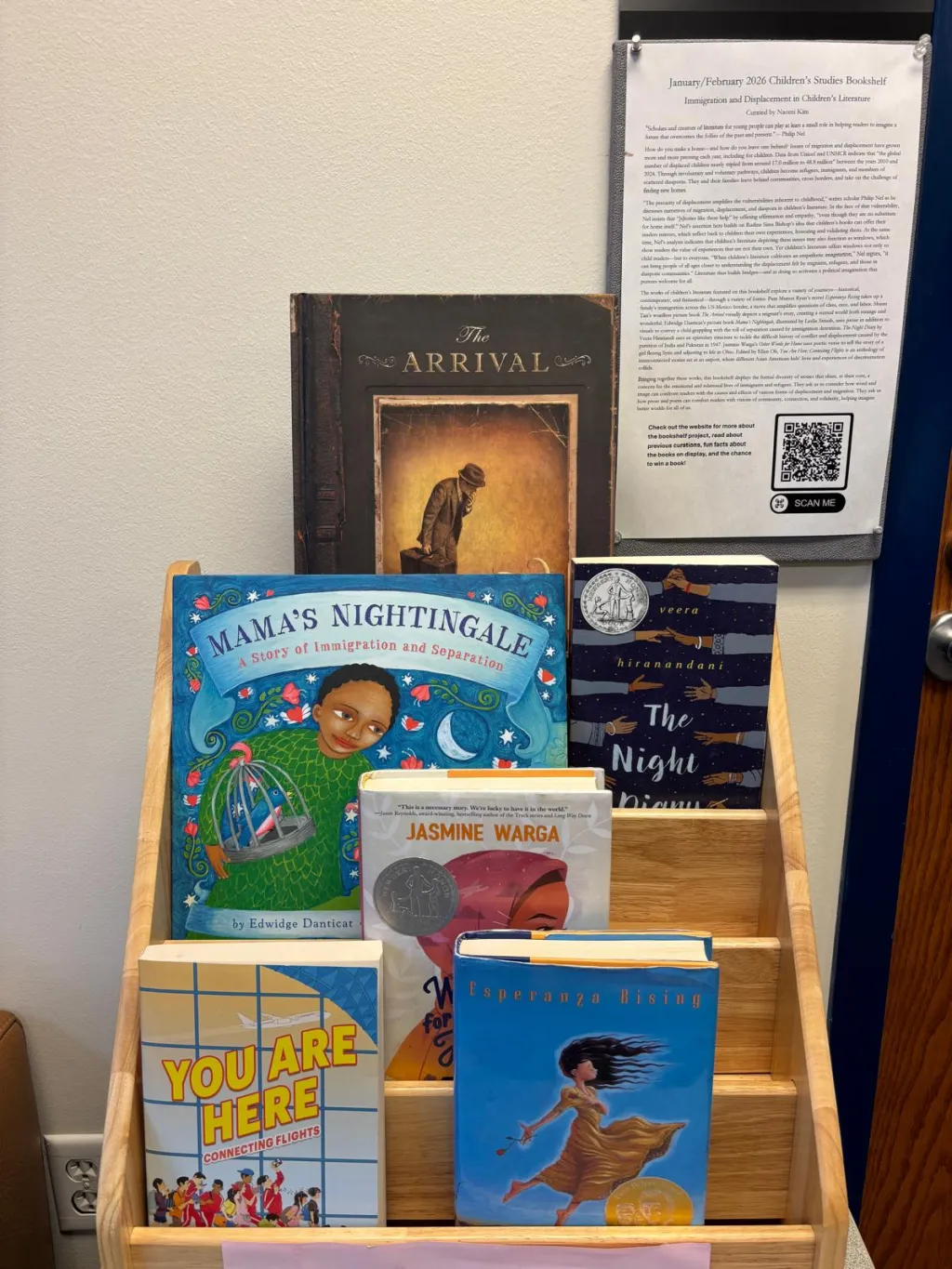
Set in the 1930s, Pam Munoz Ryan’s Newbery-winning novel Esperanza Rising (2000) takes up issues of racism, class, and farm labor against the backdrop of the Dust Bowl and the Great Depression. Esperanza Ortega is the privileged daughter of a wealthy family in Mexico—until her father’s murder changes her family’s fortunes. Forced to flee to the United States, Esperanza, her mother, and their former servants settle in a farm camp to take on agricultural work. Labor tensions simmer, and poor working conditions lead to coughs and fevers. Meanwhile, Esperanza struggles to adjust to her new reality, one in which she now occupies a marginal class and race status, but over time, she builds strong friendships and learns to hold on to hope— the very thing her name means in Spanish.

-NK

You Are Here: Connecting Flights

Set in a busy airport, You Are Here: Connecting Flights (2024) brings together twelve interconnected stories of young Asian Americans navigating friendships, belonging, and discriminatory hostility. The choice of an airport setting calls our attention not only to travel but also to immigration, and the interconnected form serves as a reminder that we live in an interconnected world, a social ecosystem. Inclusive of both East and Southeast Asian American characters and writers, the anthology features a star-studded line-up of contributing writers, including Erin Entrada Kelly, Christina Soontornvat, Grace Lin, and Linda Sue Park.

-NK

The Night Diary

Through twelve-year-old Nisha’s journal entries, Veera Hiranandani’s The Night Diary (2018) takes up the effects of the 1947 partition of colonial British India into two independent countries, India and Pakistan. Nisha comes from a mixed religious background—Muslim and Hindu—and the partition raises pressing questions about belonging, identity, and safety. As Nisha and her family become refugees, fleeing across the new border, she records the journey in her diary, addressing her entries as letters to her deceased mother.

-NK

Other Words for Home

Author Jasmine Warga, whose immigrant father was born in Jordan to Palestinian refugees, has explained that as a child, she faced a lack of representation—until post-9/11 depictions burst onto the media scene with largely pejorative views of Muslims and Arabs. Growing up with both invisibility and Islamophobia influenced Warga’s desire to increase positive Arab American representation through her own writing, including Other Words for Home (2019). Twelve-year-old Jude and her family live in a coastal town in Syria, but as the Syrian Civil War unfolds, she and her mother flee to join her uncle’s family in Cincinnati, Ohio. School, language, friendships, food, and even family life are rendered unfamiliar and challenging with the move. In free verse, Jude spins lyrical lines that convey her struggle to adjust to life in the United States as a Muslim and an Arab.

-NK

Mama's Nightingale: A Story of Immigration and Separation

Edwidge Danticat’s picture book Mama’s Nightingale (2015), illustrated by Leslie Staub, features a Haitian family in the U.S. dealing with separation caused by the detention of undocumented immigrants. Saya’s mother has been taken to the “Sunshine Correctional” because of her immigration status. Struggling with the separation, Saya finds comfort in listening to recordings of her mother telling stories and eventually writes her own. Danticat’s writing weaves in Haitian Creole and demonstrates the liberating power of storytelling, while Staub’s illustrations feature birds and birdcages as visual motifs that emphasize freedom and incarceration. Both word and image work together in Mama’s Nightingale as a testament to the difference that art in various forms can make.

-NK

The Arrival

Shaun Tan’s The Arrival (2006) is a treat to read, telling the story of one migrant’s journey solely through surreal illustrations. Our main character leaves behind his home, travels across the ocean, and arrives in a unfamiliar country to make a new home, where his family eventually joins him. By omitting any form of recognizable language or writing, Tan conveys the language barrier that the migrant faces—and puts the reader in his shoes. Both the character and the reader are forced to attend carefully to visual cues to make sense of a disorienting world. Yet despite the fantastical setting of The Arrival, Tan’s illustrations include details reminiscent of “real-world” histories, like Ellis Island, that remind us how his tale is rooted in the real immigrant experiences.

-NK

Esperanza Rising

Set in the 1930s, Pam Munoz Ryan’s Newbery-winning novel Esperanza Rising (2000) takes up issues of racism, class, and farm labor against the backdrop of the Dust Bowl and the Great Depression. Esperanza Ortega is the privileged daughter of a wealthy family in Mexico—until her father’s murder changes her family’s fortunes. Forced to flee to the United States, Esperanza, her mother, and their former servants settle in a farm camp to take on agricultural work. Labor tensions simmer, and poor working conditions lead to coughs and fevers. Meanwhile, Esperanza struggles to adjust to her new reality, one in which she now occupies a marginal class and race status, but over time, she builds strong friendships and learns to hold on to hope— the very thing her name means in Spanish.

-NK

You Are Here: Connecting Flights

Set in a busy airport, You Are Here: Connecting Flights (2024) brings together twelve interconnected stories of young Asian Americans navigating friendships, belonging, and discriminatory hostility. The choice of an airport setting calls our attention not only to travel but also to immigration, and the interconnected form serves as a reminder that we live in an interconnected world, a social ecosystem. Inclusive of both East and Southeast Asian American characters and writers, the anthology features a star-studded line-up of contributing writers, including Erin Entrada Kelly, Christina Soontornvat, Grace Lin, and Linda Sue Park.

-NK

The Night Diary

Through twelve-year-old Nisha’s journal entries, Veera Hiranandani’s The Night Diary (2018) takes up the effects of the 1947 partition of colonial British India into two independent countries, India and Pakistan. Nisha comes from a mixed religious background—Muslim and Hindu—and the partition raises pressing questions about belonging, identity, and safety. As Nisha and her family become refugees, fleeing across the new border, she records the journey in her diary, addressing her entries as letters to her deceased mother.

-NK

Other Words for Home

Author Jasmine Warga, whose immigrant father was born in Jordan to Palestinian refugees, has explained that as a child, she faced a lack of representation—until post-9/11 depictions burst onto the media scene with largely pejorative views of Muslims and Arabs. Growing up with both invisibility and Islamophobia influenced Warga’s desire to increase positive Arab American representation through her own writing, including Other Words for Home (2019). Twelve-year-old Jude and her family live in a coastal town in Syria, but as the Syrian Civil War unfolds, she and her mother flee to join her uncle’s family in Cincinnati, Ohio. School, language, friendships, food, and even family life are rendered unfamiliar and challenging with the move. In free verse, Jude spins lyrical lines that convey her struggle to adjust to life in the United States as a Muslim and an Arab.

-NK

Mama's Nightingale: A Story of Immigration and Separation

Edwidge Danticat’s picture book Mama’s Nightingale (2015), illustrated by Leslie Staub, features a Haitian family in the U.S. dealing with separation caused by the detention of undocumented immigrants. Saya’s mother has been taken to the “Sunshine Correctional” because of her immigration status. Struggling with the separation, Saya finds comfort in listening to recordings of her mother telling stories and eventually writes her own. Danticat’s writing weaves in Haitian Creole and demonstrates the liberating power of storytelling, while Staub’s illustrations feature birds and birdcages as visual motifs that emphasize freedom and incarceration. Both word and image work together in Mama’s Nightingale as a testament to the difference that art in various forms can make.

-NK

The Arrival

Shaun Tan’s The Arrival (2006) is a treat to read, telling the story of one migrant’s journey solely through surreal illustrations. Our main character leaves behind his home, travels across the ocean, and arrives in a unfamiliar country to make a new home, where his family eventually joins him. By omitting any form of recognizable language or writing, Tan conveys the language barrier that the migrant faces—and puts the reader in his shoes. Both the character and the reader are forced to attend carefully to visual cues to make sense of a disorienting world. Yet despite the fantastical setting of The Arrival, Tan’s illustrations include details reminiscent of “real-world” histories, like Ellis Island, that remind us how his tale is rooted in the real immigrant experiences.

-NK